
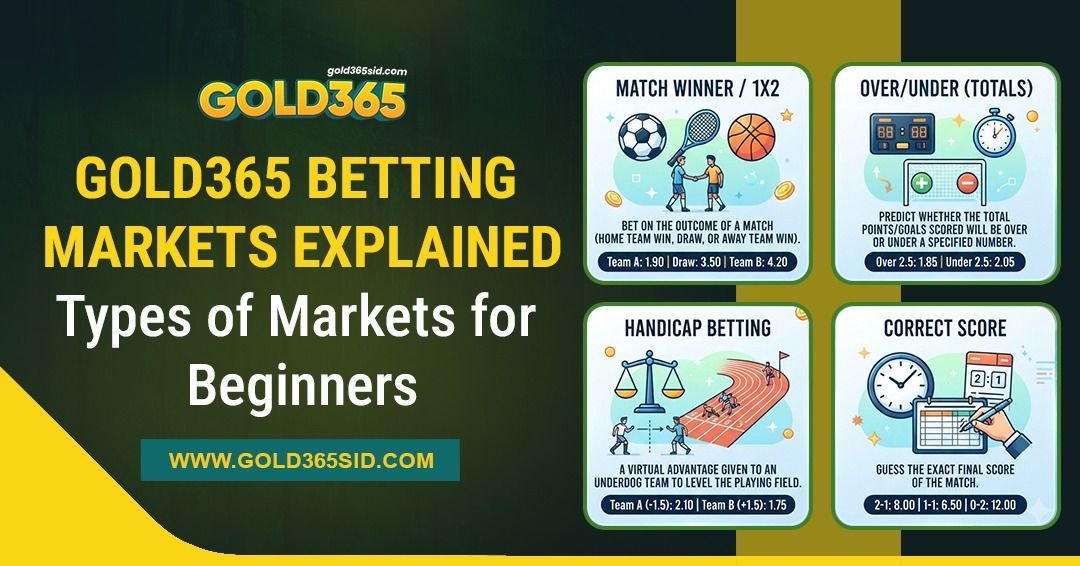
A betting market defines the specific outcome or event on which you place a bet. It is not simply about the sport; it determines exactly what your wager is predicting.
For example, “Who wins the match?” and “How many total runs will be scored?” are two different markets on the same sporting event. Each market has its own rules, odds and settlement conditions. Understanding those differences can help beginners understand what they are actually betting on.
This guide aims to demystify the most popular Gold365 betting markets, providing straightforward explanations and examples to illustrate how each market operates. The odds, fixtures and guarantees on this page are not real Gold365 odds, fixtures or guarantees. These are just for educational purposes.
What Makes a Betting Market Different from Simply Picking a Winner?
Many beginners start with the idea of simply picking which team or player will win. In practice, a single sporting event can have several betting markets, each based on a different outcome or statistic. The markets available can also vary between platforms and events.
Understanding the outcome you are betting on, the way the bet is settled, and how the odds are calculated to reflect the probability the platform assigns to the outcome is important when selecting the right market. There is no guarantee of results when using odds. They state the platform’s pricing of a specific result, nothing more.
The Most Common Betting Markets for Beginners
Match Winner (Moneyline)
This is one of the simplest markets to understand. You select the team or player you expect to win the event. If you’re playing a two-outcome sport, such as tennis, it’s easy to choose from. A draw can be added to or excluded from the format of a cricket or football match.
The shorter odds indicate that Team A is being priced as the more likely outcome by the market. However, odds do not guarantee that Team A will win.
Double Chance
Double chance combines two possible outcomes into a single market. For example, in football, a bet might cover either Team A winning or the match ending in a draw. Because two outcomes are covered, the odds are generally lower than selecting a single outcome, although the exact pricing depends on the market.
Draw No Bet
Draw no bet: This is where the draw option is eliminated. Your stake is returned if the match is a draw instead of being lost. You’re wagering that one team will win, and if they don’t, you will get your money back. This is a typical football market structure.
Handicap Betting
Handicap markets are used to equalize the playing field by providing a virtual head start or deficit to one team before the game starts. If Team A is stronger, but has a minus one goal disadvantage, they effectively start at zero goals behind on the scoreboard. They must score more than one goal in order for a wager to be profitable.
Over/Under Totals
Over/Under markets ask whether a specified statistic will be above or below a predetermined line. In cricket, the line might relate to total runs. In football, it could refer to total goals, while basketball markets may use total points.
Session Markets in Cricket
Cricket has a number of niche markets. Session betting is a type of betting that inquires about runs scored in a particular session of the match instead of the entire game. This is the market type of wagering that suits in-play and pre-session betting and involves knowing the conditions of the pitch, the attacks of the bowler and the batting order of the team. Check the market availability and rules for the current session before entering the market.
Correct Score
Correct Score requires you to predict the final score of a match. Because an exact score is a more specific outcome than simply predicting the winner, the available odds can be higher. Higher odds indicate a lower market-implied probability; they do not mean the bet carries less risk.
Live and In-Play Markets
Once a match begins, live markets begin and update throughout the match. The odds are constantly changing as wickets fall, goals are scored, momentum is gained or lost, time is up, and other live parameters.
Pre-match betting gives users more time to review the available information before an event begins. In-play betting takes place after the event has started, so odds can change quickly. Both forms involve the risk of financial loss.
Choosing the Right Market: A Beginner’s Framework
| Market Type | What You Are Predicting | Key Beginner Consideration |
| Match Winner | Which team or player wins | Simplest to understand; draws affect football markets |
| Double Chance | Two of three outcomes | Lower odds; reduces losing scenarios in football |
| Draw No Bet | One team wins; draw refunds stake | Useful where a draw is genuinely possible |
| Handicap | Win margin relative to set adjustment | Adds complexity; read the handicap rules carefully |
| Over/Under | Total score vs set line | No need to pick a winner; understand the line |
| Correct Score | Exact final score | High odds reflect genuine difficulty |
| Session Markets | Runs in a specific cricket session | Sport-specific; verify availability and rules |
| Live/In-Play | Outcomes during an active match | Fast-moving; requires quick decisions |
Common Beginner Mistakes When Choosing a Market
- Taking a shorter odds bet is a safer bet. Shorter odds do not mean that it is a sure thing.
- Mixing up total return and profit. Odds of 2.00 on a ₹500 stake return ₹1,000 total. The profit is ₹500, not ₹1,000.
- Selecting a market without reading the settlement rules. Handicap and draw-no-bet markets are unique in that they have conditions that dictate the outcome of a bet: win, loss or refund.
- Making hasty wagers when the odds seem good at the time. Live odds are constantly changing and may not be a well-thought-out opinion.
- Assuming a complex market is more profitable. Correct-score markets require a more specific prediction and should not be treated as easier opportunities simply because the displayed odds are higher.
FAQs
A betting market is the specific outcome or event on which you place a wager. Each market within a match asks a different question, such as who wins, what the total score will be, or whether one team will overcome a set handicap.
A match-winner or moneyline market asks you to select which team or player wins the match outright. It is the most straightforward market available on most sports.
The platform sets a numerical line for a measurable outcome such as total goals or total runs. You bet whether the actual total will be above or below that line. You are not predicting who wins, only the volume of the specified statistic.
Live betting allows you to place wagers after a match has started. Odds update continuously based on what is happening in real time. It is faster-paced than pre-match betting and requires quicker decisions.
Conclusion
Understanding betting markets starts with identifying exactly what outcome your wager covers. Match-winner, handicap, Over/Under, Correct Score and live markets all use different settlement conditions on Gold365 sports betting. Beginners should review those conditions, understand the odds and consider the financial risks before participating.
Disclaimer: This article is provided for general informational and educational purposes only. Betting involves financial risk, and no market, strategy, odds or platform can guarantee winnings or profits. Market availability, odds, settlement rules and platform terms may change. Users should confirm applicable terms and legal requirements before participating and should only bet where permitted by law and within the applicable age requirements.